
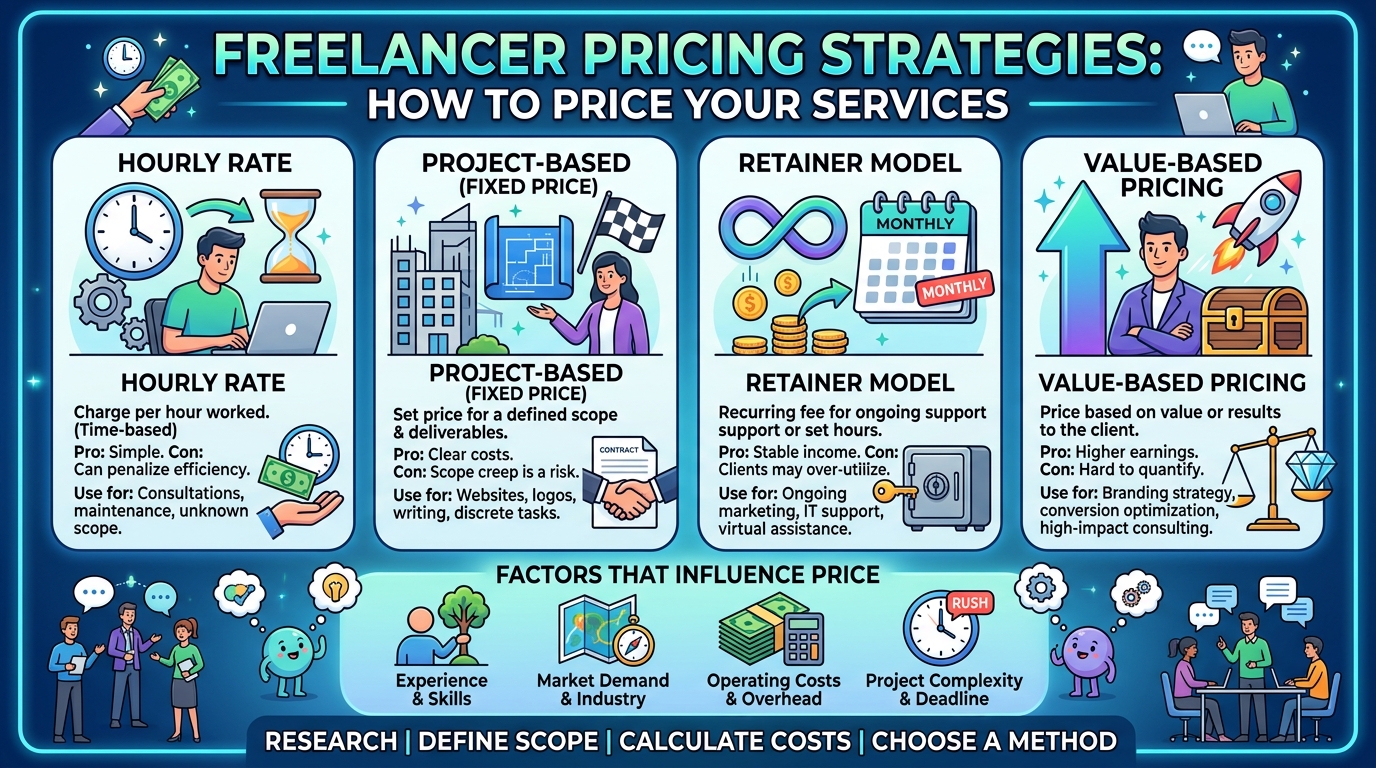

How Do Freelancers Price Their Services Without Undercharging?: To price your services without undercharging, you must reverse-engineer your rates by calculating your Minimum Acceptable Rate (MAR). Instead of guessing or copying competitors, add your target net personal income, your annual business overhead (software, hardware, insurance), and your self-employment tax liabilities. Crucially, divide this total only by your billable hours (the hours you spend on actual client work, which typically makes up only 50% to 60% of your total working time), rather than a standard 40-hour workweek.
The fundamental formula to establish your absolute pricing floor is:
Hourly Pricing Floor = Target Annual Income + Business Expenses + Taxes / Total Annual Weeks x Weekly Billable Hours

Hourly Pricing Floor
To completely eliminate the guesswork, avoid costly math mistakes, and discover your true market value in seconds, plug your specific business expenses into our free freelance pricing calculator.
Pricing independent client services is notoriously difficult. Ask three different contractors how they set their rates, and you’ll likely get three entirely different answers—usually ranging from copying marketplace averages to pulling a random number out of thin air.
But when you build a business on guesswork, you inevitably undercharge. Undercharging strains your cash flow, leaves you vulnerable to sudden economic shifts, and forces you into a state of chronic burnout. If you want to build a sustainable independent business, your financial strategy requires mathematical certainty. Let's explore how to systematically value your expertise, account for hidden overhead, and confidently command premium fees.
1. The Cost-Plus Pricing Strategy: Building Your Financial Floor
The absolute foundation of learning how do I start working as a freelancer without losing money is shifting from an "employee mindset" to an "owner mindset."
When you work a traditional corporate job, your employer quietly subsidizes your life. They provide your computer, pay for your software licenses, handle your health insurance, and contribute to your retirement. When you go out on your own, you become the employer. Every single one of those overhead costs must now be built directly into your pricing architecture.
The Hidden Overhead Trap: Failing to build operational costs into client fees is the number one reason solo businesses fail within their first two years.
To make sure your rates can actually support your lifestyle, you must learn the foundational mechanics of how to calculate self employed income. If you are transitioning away from a structured salary, it is critical to map out exactly what are the hidden costs of leaving a full-time job to go full-time freelancing so your business remains structurally profitable from day one.
If you suspect you are currently trading your limited time for far too little return, take our fast Freelance Profitability Quiz to stop guessing your worth and instantly isolate where your business model is leaking money.
2. Navigating the Realities of Billable Efficiency
The most dangerous math mistake independent contractors make is assuming they can bill for 40 hours of work a week.
In the real world, running an independent consulting business requires a massive amount of non-billable administrative drag. You have to hunt for leads, send pitches, write proposals, build contracts, issue invoices, and manage your own marketing.
Your Total Weekly Working Hours (e.g., 40 Hours)
 ├── Billable Execution Time (50% - 60%): Actual designing, programming, writing.
 └── Non-Billable Admin Drag (40% - 50%): Pitching, invoicing, client management.
Because your billable efficiency ratio usually hovers around 50% to 60%, your active client execution hours must fully absorb and fund your administrative time. If you ignore this reality, you are effectively working half your week for free.
Whether you are trying to understand how do I determine an hourly rate as a freelancer or consultant for corporate projects, or specifically configuring how do you determine your hourly rate for freelance writing side hustles, your billing metrics must adjust to protect your available time. To see this breakdown in action, explore our complete technical walkthrough on how do I calculate a profitable rate using a freelance pricing calculator.
3. Calibrating to Your Specialized Industry Baseline
While your internal expenses set your absolute financial floor, your specific target niche determines your optimal revenue ceiling. To ensure your quotes line up with real-world industry standards, cross-reference your pricing baseline with our specialized niche valuation engines:
- Creative Strategy & Design: Visual creators often struggle with client feedback loops and extensive revision cycles that erode initial profit margins. Secure your delivery time using our dedicated Graphic Designer Pricing Calculator.
- Software Development & Engineering: Writing clean, scalable code requires deep technical expertise and long discovery periods. Protect your structural pricing brackets using our advanced Freelance Developer Rate Calculator.
- Direct-Response Copywriting: Crafting high-converting sales assets requires complex marketing psychology and extensive target research. Isolate your baseline value with our Freelance Copywriter Hourly Rate Finder.
4. Scaling Past Marketplace Limitations to Value-Based Fees
When professionals first launch a business, they frequently look at what hourly rate can you get from those freelancing sites like Upwork. While open freelance platforms can help you secure initial portfolio pieces, relying on them long-term forces you to compete entirely on price rather than value.
If you constantly find yourself undercutting your own skills just to close deals, perform an objective assessment of your current pipeline by checking out our guide on whether are you undercharging clients.
For those successfully expanding a part-time operation into a full-scale corporate consultancy, learning how to shift your operational strategy from side hustle to full-time income will give you a clear, low-risk roadmap to scale your business safely.
Your Professional Pricing Action Plan:
- Trade Guesswork for Cold Hard Data: Discover exactly how a freelance calculator app can increase your income by giving you the clear mathematical logic needed to stand firm during tough client budget negotiations.
- Review Your Numbers Before Every Single Pitch: Never send out a blind estimate. Make it an absolute business rule to process your project targets through our optimized freelance calculator app and discover why every freelancer needs a rate calculator before sending a proposal.
- Master the Art of Flat-Fee Scoping: Once you are ready to graduate past basic hourly billing, study the smart freelancer's guide to pricing projects accurately in 2026 to package your work into high-margin, value-backed flat milestones.
- Claim Your True Competitive Edge: Stop allowing anxiety to dictate your market value. Read our strategic blueprint on unlocking your true freelance worth to discover how to properly communicate your unique business value to premium clients.
For custom financial forecasting tools, automated overhead tracking widgets, and professional solo business calculators, explore why every independent professional should use a freelancer fees calculator to safeguard their bottom line.
One thought on “How Do Freelancers Price Their Services Without Undercharging?”