
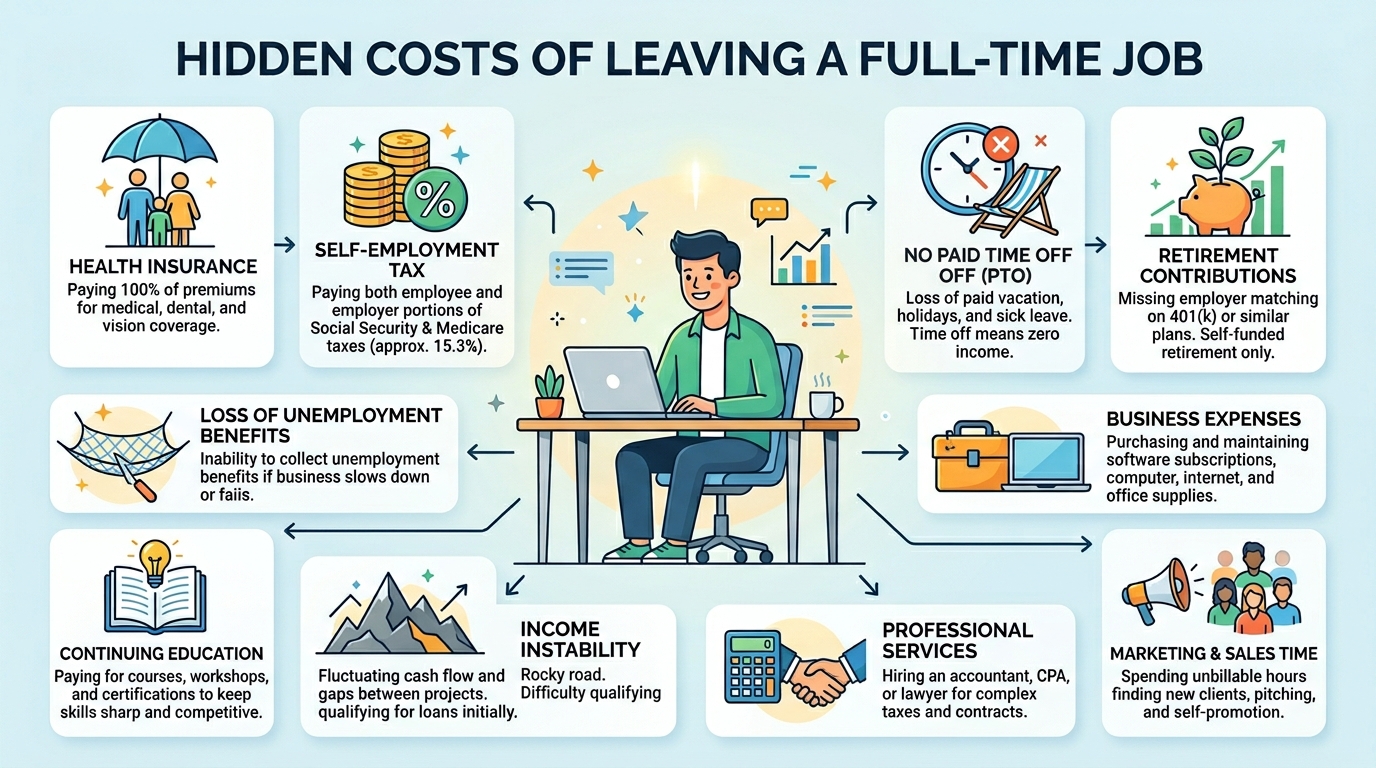

What Are the Hidden Costs of Leaving a Full-Time Job to Go Full-Time Freelancing?: The hidden costs of leaving a full-time job for freelancing include losing employer-provided benefits, paying your own taxes, dealing with inconsistent income, covering business expenses, managing unpaid administrative work, and sacrificing job security.
Many people focus on the freedom of freelancing but underestimate the financial responsibilities that come with being self-employed. While freelancing can eventually provide greater income potential and flexibility, understanding these hidden costs is essential before making the transition.
The Hidden Costs of Leaving a Full-Time Job to Go Full-Time Freelancing
For many professionals, freelancing represents freedom.
No more commuting.
No more office politics.
No more asking permission for vacation time.
The idea of being your own boss and working on your own terms is incredibly appealing. It's no surprise that millions of people dream about turning their side hustle into a full-time career.
However, one of the biggest mistakes aspiring freelancers make is focusing exclusively on the benefits while ignoring the hidden costs.
The reality is that leaving a traditional job doesn't just change how you earn money—it changes how you manage every aspect of your financial life.
Before handing in your resignation letter, it's worth understanding what you're actually giving up and what new responsibilities you'll be taking on.
1. You Lose Employer Benefits
Many employees underestimate the value of the benefits attached to their jobs.
These benefits often include:
- Health insurance
- Paid vacation
- Paid sick leave
- Retirement contributions
- Life insurance
- Professional development programs
- Employee discounts
When you become a freelancer, these benefits disappear.
You become responsible for replacing them yourself.
While freelancing may offer higher earning potential, you'll often need a portion of that income just to recreate benefits you previously received automatically.
2. Taxes Become Your Responsibility
As an employee, taxes are often deducted automatically from your paycheck.
As a freelancer, you become responsible for:
- Calculating taxes
- Tracking income
- Recording expenses
- Setting aside tax payments
- Filing returns
This can be a significant adjustment for new freelancers.
Many first-year freelancers experience financial stress because they fail to reserve enough money for taxes throughout the year.
3. Income Becomes Less Predictable
One of the most overlooked costs of freelancing is income volatility.
A salaried employee knows exactly how much money will arrive each month.
Freelancers often experience:
- Slow months
- Delayed payments
- Project cancellations
- Seasonal demand fluctuations
Even highly successful freelancers experience income variability.
This uncertainty requires careful budgeting and a larger emergency fund than most traditional employees need.
4. You Pay for Your Own Equipment
Many employees take workplace equipment for granted.
When freelancing, you're often responsible for purchasing:
- Computers
- Monitors
- Smartphones
- Software subscriptions
- Internet upgrades
- Office furniture
These costs can add up quickly.
A freelancer who depends on technology must regularly invest in upgrades and maintenance to remain competitive.
5. Marketing Becomes Part of Your Job
When you're employed, someone else usually finds customers.
As a freelancer, client acquisition becomes your responsibility.
This may require:
- Website development
- Social media marketing
- Paid advertising
- Networking
- Portfolio management
- Content creation
Marketing takes both time and money.
And unlike client work, marketing activities aren't always immediately profitable.
6. Administrative Work Is Unpaid
One of the biggest surprises for new freelancers is how much time they spend not working for clients.
Administrative responsibilities often include:
- Responding to emails
- Creating proposals
- Scheduling meetings
- Sending invoices
- Following up on payments
- Updating contracts
These activities are essential but generally unpaid.
Many freelancers discover that a significant percentage of their working hours generate no direct revenue.
7. You Need a Larger Emergency Fund
Employees often have some level of financial predictability.
Freelancers need a larger financial cushion because income can fluctuate dramatically.
Many experts recommend having several months of living expenses saved before transitioning to full-time freelancing.
This emergency fund can provide stability during slow periods and help reduce financial stress.
8. Burnout Can Become More Common
Many new freelancers believe they'll work less after leaving traditional employment.
The opposite often happens.
Freelancers frequently juggle:
- Client work
- Sales
- Marketing
- Accounting
- Customer service
- Business development
Without clear boundaries, work can easily expand into evenings and weekends.
Learning to manage workload effectively becomes essential for long-term success.
9. Professional Development Is Self-Funded
Most industries evolve rapidly.
Employees often receive employer-sponsored training.
Freelancers must invest in:
- Courses
- Certifications
- Conferences
- Books
- Coaching programs
While these investments can increase earning potential, they represent an additional cost that many people fail to anticipate.
10. The Emotional Cost of Uncertainty
Financial costs aren't the only consideration.
Freelancing can introduce emotional challenges such as:
- Uncertainty about future income
- Client dependency
- Isolation
- Rejection
- Business risk
Some people thrive in this environment.
Others find the uncertainty significantly more stressful than traditional employment.
Understanding your personal tolerance for risk is an important part of deciding whether freelancing is right for you.
The Opportunity Side of Freelancing
Despite these hidden costs, freelancing can still be an excellent career choice.
Many freelancers eventually enjoy:
- Higher income potential
- Flexible schedules
- Location independence
- Greater control over projects
- More direct rewards for their efforts
The key is entering freelancing with realistic expectations.
Those who understand both the benefits and costs are often better prepared to succeed.
Final Thoughts
Leaving a full-time job to become a freelancer isn't simply changing where you work—it's changing how you earn, manage, and protect your income.
The hidden costs include more than just money. They involve time, responsibility, planning, and risk management.
Before making the leap, evaluate your finances carefully, build an emergency fund, understand your business expenses, and create a plan for replacing the benefits and stability provided by traditional employment.
Freelancing can be incredibly rewarding, but success is much easier when you understand the full picture before you start.
7 thoughts on “What Are the Hidden Costs of Leaving a Full-Time Job to Go Full-Time Freelancing?”